

Arabic for Kids: How to Help Your Child Learn Arabic at Home and Online
Looking for an Arabic learning app for kids? Compare real options by age and goal, and get a simple home routine that keeps Arabic alive in your family.
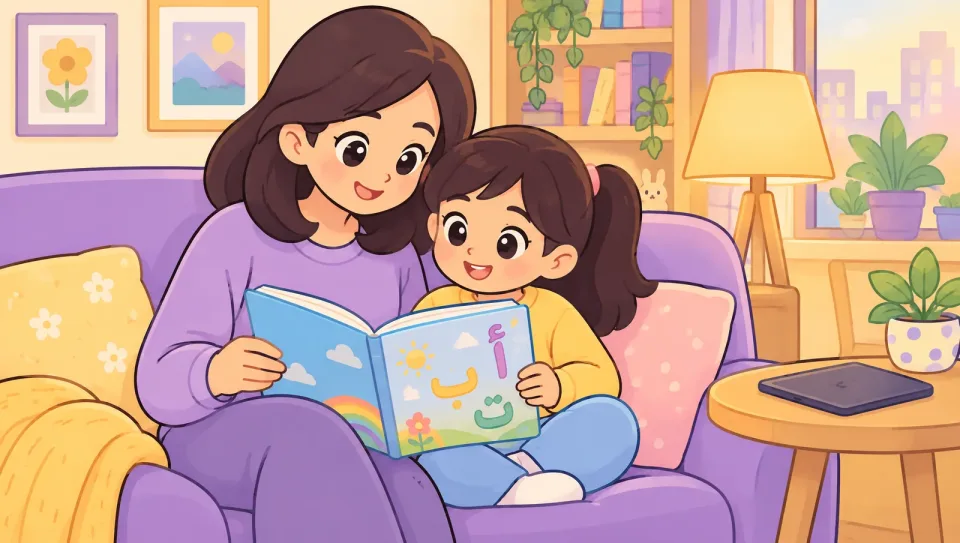
The best way to help your child learn Arabic is real, daily use at home, with an Arabic learning app for kids or an online program as support, not a replacement. Pick a tool that fits your child's age and goal: stories and listening for young children, leveled reading for school-age kids, and conversation practice for children who understand Arabic but answer in English.
Quick summary
- Home use matters most. In one large study, children nearly always spoke the family language when both parents used it at home.
- Match the tool to the goal: letters and sounds, reading, stories, or speaking.
- Short and often beats long and rare. Ten minutes a day works better than one long Saturday session.
- Apps help most when you sit with your child and talk about what they did.
- No app teaches Arabic alone. Family, community, and sometimes a teacher do the heavy lifting.
Why do so many kids abroad lose their Arabic?
If your child understands you in Arabic but replies in English, you're not alone. Pew Research Center reports that about 1.4 million people in the US spoke Arabic at home in 2021 (Pew Research Center, 2023), up from 215,000 in 1980. Pew also notes that about two-thirds of Arabic speakers aged 5 to 17 were born in the US. These kids grow up surrounded by English at school, on screens, and with friends.
Canada shows a similar picture. Statistics Canada found that about 290,000 people mainly spoke Arabic at home in 2021 (Statistics Canada, 2022), making it the fifth most common language other than English or French.
The research on keeping a family language is clear about one thing: what happens at home counts most. Linguist Annick De Houwer surveyed close to 2,000 families in Flanders, Belgium, where at least one parent spoke another language. As psychologist François Grosjean summarizes (Psychology Today, 2014), nearly one-quarter of those families had no child who spoke the family language. When both parents used only that language at home, the rate of children speaking it was about 97%. The original study appears in Applied Psycholinguistics (De Houwer, 2007).
That's not a reason to feel guilty if your family mixes languages. Most of us do. It just tells you where your effort pays off: more Arabic in everyday life, not just more Arabic lessons.
What should you look for in an Arabic learning app for kids?
Before you download anything, answer two questions: How old is your child, and what do you want them to be able to do?
| Your goal | What to look for | Best fit age |
|---|---|---|
| Recognize letters and sounds | Short phonics games, audio for every letter, tracing | 3 to 6 |
| Read Arabic on their own | Leveled books, audio read-along, word highlighting | 5 to 12 |
| Love Arabic stories | Large story library, narration, topics kids enjoy | 4 to 10 |
| Speak and answer in Arabic | Two-way conversation, voice input, patience with mistakes | 6 to 14 |
| Formal Arabic for school | A structured curriculum, assessments, a teacher | All ages |
A few quality checks apply to any app. A widely cited review of educational apps in Psychological Science in the Public Interest (Hirsh-Pasek et al., 2015) found that children learn more when an app keeps their mind active (not just tapping), avoids distracting extras, connects to their real life, and invites conversation with others. So ask yourself:
- Does my child think, or just tap and swipe?
- Is there a lot of noise, ads, or unrelated mini-games?
- Can I connect what they learn to our family life?
- Will we talk about it together afterward?
Which apps and programs can help your child learn Arabic online?
Here are real options we checked on their official sites or app store listings in October 2026. This isn't a ranking. Each one serves a different goal. Prices and features change, so check the official page before you subscribe.
Lamsa (stories and early learning, ages 0 to 5)
Lamsa is a bilingual Arabic and English early learning app. Its App Store listing describes more than 1,200 interactive games, videos, and activities covering letters, math, science, and social-emotional skills. It's free to download with in-app subscriptions. It's best for preschoolers and toddlers, so older kids may outgrow it.
I Read Arabic (leveled reading, ages 4 to 18)
I Read Arabic from Little Thinking Minds is an Arabic reading app for kids built around leveled books. Its site lists more than 800 books with audio and 23 reading levels, plus listening and voice-recording features. Parents can see an activity report. It offers a free trial; the page doesn't list prices.
Kutubee (Arabic and English e-books, ages 3 to 14)
Kutubee is a digital reading platform with more than 1,700 Arabic and English titles from publishers, grouped by age and reading level. It includes word highlighting and questions after reading, and it's used both at home and in schools. It's a good pick if you want an Arabic stories for kids app with real published books.
Duolingo Arabic (self-study for older kids and parents)
Duolingo's Arabic course for English speakers is free and uses short, game-like lessons. It's designed for general learners, not specifically for children, so it fits best for motivated older kids, or for a parent learning alongside a child. It won't replace conversation with real people.
A live teacher or weekend school
For formal Arabic, grammar, or religious study, a human teacher is still the strongest option. Many communities have weekend schools, and many teachers work online. If your child needs structure and accountability, start here and use apps between lessons.
Heynour (conversation practice, ages 6 to 14)
Heynour is an AI learning companion that a child can talk to in Arabic or English. It's a conversation tool, not a structured alphabet course. More on where it fits below.
If you're looking at learning apps more broadly (math, reading in English, coding), see our guide to the best learning apps for kids by age.
How can you build Arabic into everyday family life?
Apps are the side dish. The main meal is daily life. Here's a simple routine many families can keep.
A simple weekly routine
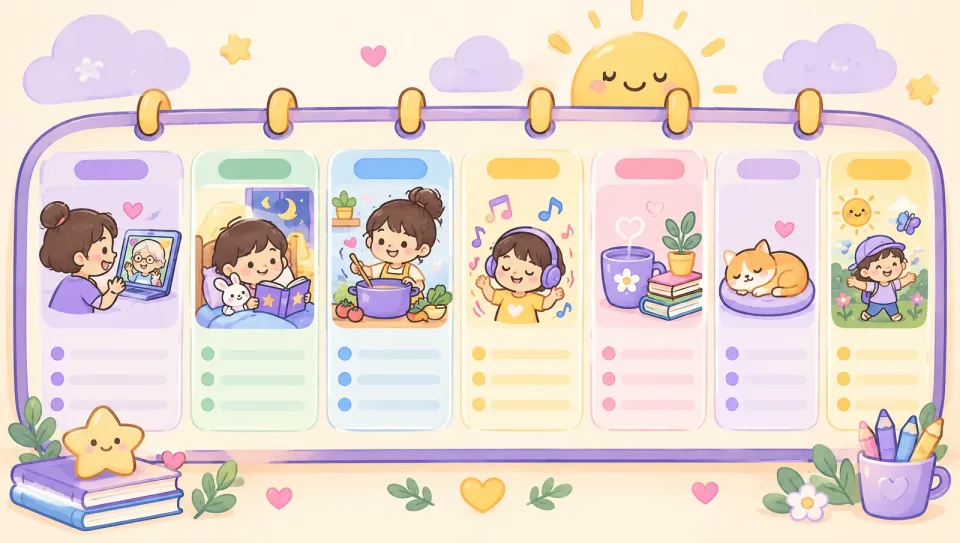
- Pick one Arabic moment every day. Breakfast, the car ride, or bath time. Keep it the same so it becomes a habit.
- Read one Arabic story at bedtime, three nights a week. Even if your child reads the English version on other nights. Our bedtime stories guide has tips for making this stick.
- Schedule a weekly call with family back home. Grandparents are the best Arabic teachers you have. Give your child one question to ask them.
- Cook one dish together and name everything in Arabic. "ملعقة" (spoon), "صحن" (plate), "ملح" (salt). Kids remember words they touch and taste.
- Use 10 minutes of app time as practice, not as the lesson. Afterward, ask, "What story did you read? Tell me in Arabic."
Small habits that make a big difference
- Answer in Arabic, even when they speak English. Do it gently, without forcing them to repeat.
- Keep Arabic fun. Songs, cartoons, and jokes count. A child who links Arabic with pressure will avoid it.
- Use dialect and formal Arabic both. Your dialect is the language of love at home. Formal Arabic (فصحى) opens books and school. Children can handle both.
- Praise effort, not perfection. "I love that you tried that word" beats correcting every mistake.
Which Arabic should kids learn: dialect or Modern Standard Arabic?
Both have a place. Your family dialect is what your child will use with grandparents and cousins. Modern Standard Arabic is what they'll read in books and hear in the news. Most families speak dialect at home and let books, apps, and school carry formal Arabic. Don't wait to "choose" before starting. Start with what you speak.
How much screen time is okay for Arabic learning?
Arabic apps still count as screen time. The American Academy of Pediatrics no longer sets one number for every child. Its 2026 guidance for families (HealthyChildren.org, AAP, 2026) focuses on quality content, using media together, and screen-free zones like mealtimes and the hour before bed. If you want ideas for the rest of the day, see our list of screen time alternatives for kids.
A practical rule: let screen time support Arabic you already use at home. If the app is the only Arabic your child hears, add one real-life Arabic moment before adding more app time.
How Heynour fits in
Heynour is an AI learning companion for kids aged 6 to 14, in Arabic and English. Your child can type, speak, or ask about any topic that interests them, and Heynour explains it at their level. They can ask it for a story in Arabic, then ask questions about it. For a child who understands Arabic but rarely speaks it, that back-and-forth can be useful low-pressure practice.
You create the account, see your child's conversations, and set a daily time limit. The free plan includes 60 minutes a week of text and voice.
Be clear on its limits: Heynour isn't an alphabet course for toddlers or a structured grammar program, and AI can make mistakes. It works best alongside your family's Arabic, not instead of it. You can see how Heynour works or compare the free and Plus plans to decide if it's a fit.
FAQ
What is the best Arabic learning app for kids?
There's no single best Arabic learning app for kids, because the right choice depends on age and goal. For preschoolers, an early-learning app with letters and songs works well. For school-age children learning to read, a leveled reading app with audio is better. For kids who understand Arabic but don't speak it, conversation practice matters most. Pair any app with daily Arabic at home.
Can my child learn Arabic online without a teacher?
A child can build vocabulary, listening, and reading skills online, especially with leveled books and audio. But learning to speak confidently, and learning grammar and formal writing, usually needs real conversation and often a teacher. Treat online tools as daily practice between family conversations and lessons, not as the whole plan. Short, regular sessions work better than long, rare ones.
At what age should kids start learning Arabic?
If Arabic is your family language, start from birth by simply speaking it at home. Children can learn two languages at the same time. For formal reading, many children begin recognizing Arabic letters around ages 4 to 6, similar to when they start reading in English. It's never too late, though. Older children and teens can learn Arabic well with motivation and regular practice.
My child understands Arabic but answers in English. What should I do?
This is very common among kids growing up abroad. Keep speaking Arabic yourself, and create moments where Arabic is the only option, like calls with grandparents who don't speak English. Ask open questions that need more than a yes or no. Celebrate any attempt, even mixed sentences. Pressure usually backfires, while fun and real need tend to work better.
Should my child learn dialect or Modern Standard Arabic first?
Start with the Arabic your family speaks, which is usually a dialect. It's the language of home, emotion, and family ties. Introduce Modern Standard Arabic through stories, songs, and books as your child grows. Most Arab children learn both: dialect for daily life and Modern Standard Arabic for reading and school. You don't need to choose one before starting.
Sources
- Pew Research Center: 5 facts about Arabic speakers in the US (2023)
- Statistics Canada: Increasing diversity of languages spoken at home (2022)
- De Houwer, A. Parental language input patterns and children's bilingual use. Applied Psycholinguistics (2007)
- Grosjean, F. The languages you speak to your bilingual child. Psychology Today (2014)
- Hirsh-Pasek et al. Putting Education in "Educational" Apps. Psychological Science in the Public Interest (2015)
- HealthyChildren.org (AAP): Helping Kids Thrive in a Digital World (2026)
- Lamsa on the App Store (checked October 2026)
- I Read Arabic (checked October 2026)
- Kutubee (checked October 2026)
- Duolingo Arabic course (checked October 2026)