

Bedtime Stories for Kids: 4 Short Original Stories + How to Build the Habit
Four short, original bedtime stories for kids aged 4 to 12, each with discussion questions, plus a simple way to build a calm reading habit at night.
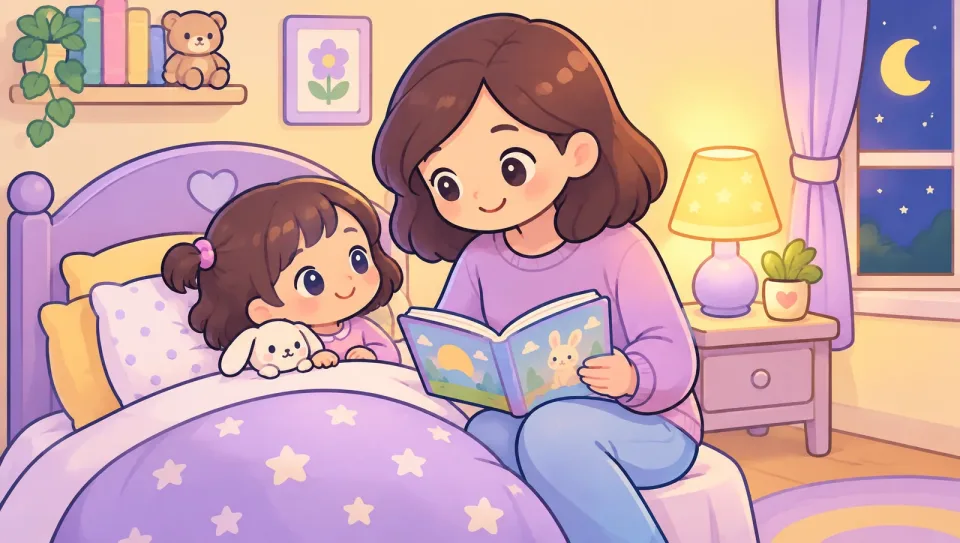
Good bedtime stories for kids are short, calm, and end on a warm note. Below are four original stories you can read tonight, each about 2 minutes long and labeled by age, with two questions to talk about afterward. Then you'll find a simple way to make bedtime reading a habit, plus an honest look at screens and audio before sleep.
Quick summary
- Read the story that matches your child's age, then ask one of the two questions.
- Keep the routine the same each night: same time, same order, same spot.
- Pediatric guidance suggests making the hour before bed screen-free when you can.
- Keep reading aloud after your child can read alone. Older kids still enjoy it.
- Apps and AI bedtime stories can help earlier in the evening, but a paper book or your own voice is the calmest option at lights-out.
Story 1: The Moon Who Lost Her Glow (ages 4 to 6)
One night, the Moon woke up and felt dim. "Oh no," she whispered. "My glow is gone."
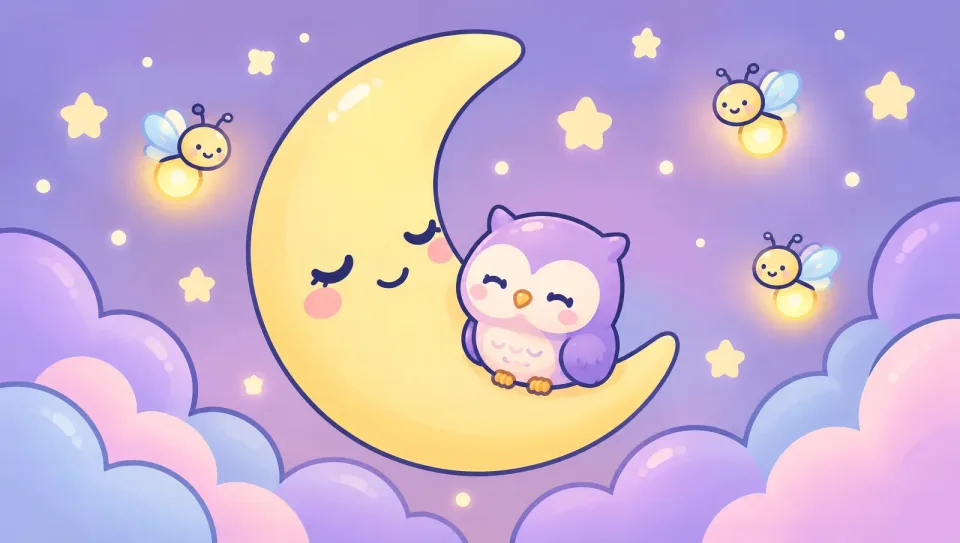
An owl looked up from his branch. "You still look lovely to me," he hooted. But the Moon felt sad. Without her glow, how would the little animals find their way home?
A tiny firefly buzzed up. "I can help," she said. "I don't have much light. But I have some."
The firefly called her sisters. Then her cousins. Then their friends. Soon a thousand small lights floated up into the sky, blinking around the Moon like a warm blanket.
Below, a rabbit found her burrow. A hedgehog found his bush. A sleepy fox found her den.
"Thank you," said the Moon. "I thought I had to shine all by myself."
"Nobody has to," said the firefly. "That's what friends are for."
Slowly, the Moon's glow came back. Maybe she'd only been tired. Maybe the fireflies helped. Either way, she smiled and shone softly over the forest until morning.
And the fireflies? They went to bed too. Even small lights need their rest.
Talk about it:
- Who helped the Moon? How did they help?
- Can you think of a time when someone helped you even with something small?
Story 2: Omar and the Very Long Sock (ages 5 to 8)
Omar was getting ready for bed when he noticed something strange. His left sock was long. Very long. It went past his knee, past his pajama shorts, and trailed out the bedroom door.
He followed it down the hall. It went past the bathroom, where his sister was brushing her teeth. "Is that your sock?" she asked, mouth full of foam.
"I think so," said Omar.
The sock went down the stairs, past the kitchen, where his dad was washing a pot. "That's a very long sock," said Dad.
"I know," said Omar.
The sock went out the back door and into the garden, where Grandma was sitting under the lemon tree, knitting.
"Grandma," said Omar, "did you make my sock?"
Grandma laughed. "I started this afternoon," she said. "I was going to stop. But I kept thinking of all the places you'll walk when you grow up, and I just kept going."
Omar sat beside her. She cut the yarn and tied it into a neat sock, just his size. Then she kept the rest of the yarn in her basket.
"For the next pair," she said, "when your feet get bigger."
Talk about it:
- Why do you think Grandma kept knitting?
- Where would you like to walk when you're grown up?
Story 3: The Lighthouse Keeper's Notebook (ages 8 to 10)
Lina's aunt kept the lighthouse on the rocky point, and every summer Lina stayed with her. Her favorite job was the notebook. Each evening, her aunt wrote down the weather, the ships that passed, and one good thing from the day.

One stormy night, the power cut out. The great lamp went dark.
"What do we do?" Lina asked, her voice small.
Her aunt was already moving. She lit the old oil lamp they kept for emergencies, and together they carried it up the spiral stairs: 112 steps. Lina counted every one.
At the top, her aunt showed her how to set the lamp behind the big glass lens. The tiny flame grew into a strong beam that swept across the waves.
Far out, a fishing boat changed course, away from the rocks.
When the storm passed, Lina's aunt handed her the notebook. "Your turn," she said.
Lina thought for a moment. Then she wrote: "Weather: storm. Ships: one fishing boat. Good thing: a small light was enough."
Her aunt read it and smiled. "That's the truest line in the whole book."
Talk about it:
- How did Lina feel at the start of the storm, and at the end?
- If you kept a notebook like this, what would your "good thing" be today?
Story 4: The Last Question (ages 10 to 12)
Yusuf was the kind of kid who asked questions. Why is the sky blue? How do birds know where to fly? What's at the bottom of the ocean?
His teacher, Ms. Haddad, had a rule. Every Friday, students could put one question in the jar on her desk. On Monday, she'd pick one and the whole class would find the answer together.
For months, Yusuf's questions never got picked. Then, near the end of the year, he wrote one he really wanted answered: "Is it okay to not know what you want to be?"
On Monday, Ms. Haddad pulled out a slip and read it aloud. The room went quiet. Yusuf's ears turned red.
"This one doesn't have an answer we can look up," she said. "So let's do something different."
She asked everyone to share what they'd wanted to be at age five. Astronaut. Cat. Ice cream truck driver. Everyone laughed. Then she told them that at their age she'd wanted to be a pilot, then a chef, then a doctor, and that she'd only decided to teach in her twenties.
"Not knowing," she said, "just means you're still collecting questions."
That night, Yusuf wrote a new question in his notebook. He didn't put it in the jar. He just wanted to keep it.
Talk about it:
- Why do you think Yusuf's ears turned red?
- What's a question you're still collecting?
Why are bedtime stories worth it?
Shared reading does more than settle kids down. A research briefing from the ESRC International Centre for Language and Communicative Development (LuCiD, 2016) summarizes studies showing that children who regularly read with an adult tend to build vocabulary faster. The same briefing notes that talking with your child about the book, not just reading the words, works better than reading straight through.
Kids also like it. Scholastic's Kids & Family Reading Report (Scholastic, 7th edition, 2019) found that more than 80% of children and parents said they love or like read-aloud time a lot. The same report shows how quickly it fades: about 45% of parents of 6- to 8-year-olds read aloud 5 to 7 days a week, but only about 21% of parents of 9- to 11-year-olds did. The most common reason parents gave for stopping was that their child could read alone.
So here's a gentle nudge: if your child is 9 or 10, don't stop. Take turns reading pages, or read a chapter book together. Story 4 above was written with older kids in mind.
How do you build a bedtime story habit that lasts?
Make it the same every night
- Pick a fixed time. Work backward from the sleep your child needs. The CDC lists 9 to 12 hours for children aged 6 to 12 (CDC, citing the American Academy of Sleep Medicine, 2016).
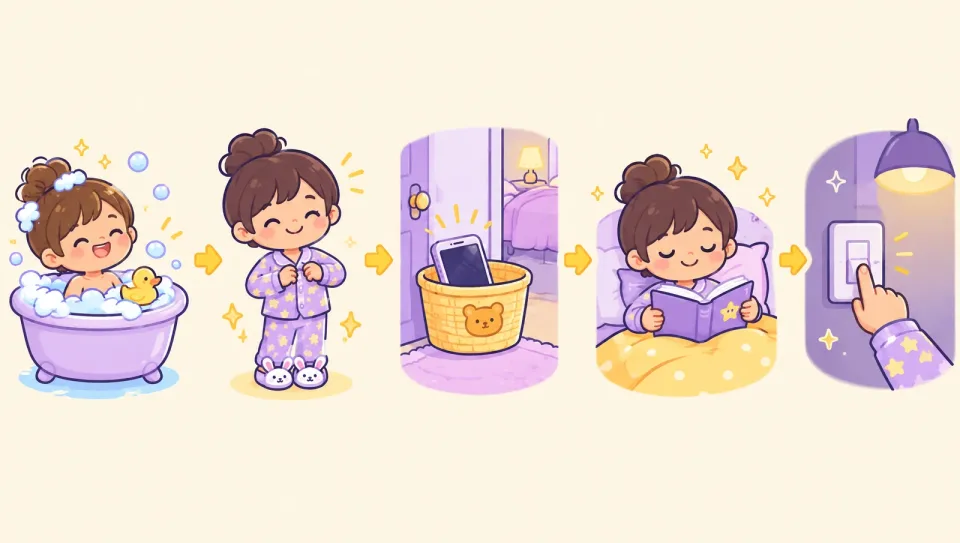
- Keep the order. Bath, pajamas, teeth, story, lights out. Predictable steps help kids wind down.
- Put screens away first. Phones and tablets go in a basket outside the bedroom before the story starts, including yours.
- Let your child choose sometimes. Offer two books and let them pick. Choice builds buy-in.
- Keep it short on hard nights. One page is better than skipping. The habit matters more than the length.
Ask, don't quiz
The two questions after each story above aren't a test. They're an invitation. If your child doesn't want to talk, that's fine. Some nights they'll surprise you with a long answer, and those conversations are often the best part.
Use your family language
If you speak Arabic or another language at home, bedtime is one of the easiest places to use it. Read in Arabic a few nights a week, or retell an English story in your own words. Our guide on Arabic for kids at home and online has more ideas.
Are screens, apps, and AI bedtime stories okay before sleep?
Here's the honest answer: the closer you get to lights-out, the less screen time helps.
The American Academy of Pediatrics' 2026 guidance for families (HealthyChildren.org, AAP, 2026) suggests bedrooms and mealtimes as screen-free zones, especially in the hour before bed, and encourages parents to put their own phones away at bedtime too. Research backs this up. A systematic review in Sleep Medicine Reviews (Hale & Guan, 2014) looked at 67 studies of school-age children and teens and found that 90% reported a negative link between screen time and sleep, such as falling asleep later or sleeping less.
What about a bedtime stories app or audio stories?
A bedtime stories app can be useful, especially for nights when you're traveling or too tired to read. A few practical tips:
- Use it earlier. Let your child pick or listen to a story during the wind-down hour before the screen-free hour starts.
- Prefer audio with the screen off. If you use audio at bedtime, put the device face-down or out of reach so your child isn't tempted to scroll. We didn't find specific pediatric guidance on audio-only stories, so use your judgment and watch how your child sleeps.
- Stay in the room sometimes. An app can tell a story, but it can't cuddle or answer "why" the way you can.
Can AI bedtime stories be good for kids?
AI bedtime stories can be fun because kids can shape them: "a story about a cat who becomes an astronaut." That kind of creativity is real. But the AAP's article on AI chatbots and kids (HealthyChildren.org, 2025) reminds parents that general chatbots aren't designed with children in mind and can produce inaccurate or unsuitable content. If your child uses AI for stories, choose a tool built for kids, sit nearby, and read the story together. Keep it out of the bedroom at lights-out.
For more ideas on calm evening activities without screens, see our list of screen time alternatives for kids.
How Heynour fits in
Heynour is an AI learning companion for kids aged 6 to 14, in Arabic and English. Your child can ask it for a story on any topic they love, in either language, and then ask questions about it. Younger kids can have the story read aloud. It works well during the early-evening wind-down, before the screen-free hour starts.
As a parent, you see your child's conversations and set a daily time limit, so stories don't slide into extra screen time.
The honest limit: Heynour doesn't replace you reading at the bedside, and AI can make mistakes, so it's worth reading along. If you'd like to try it, you can see how Heynour works or start with the free plan.
FAQ
What are good short bedtime stories for kids?
Good short bedtime stories for kids take 2 to 5 minutes to read, have a simple problem and a calm, happy ending, and avoid scary twists. Stories about kindness, family, nature, and small adventures work well. For younger children, repetition and gentle sounds help. For older kids, a story with a small question to think about can spark a nice conversation before sleep.
What age should you stop reading bedtime stories?
There's no age when you have to stop. Scholastic's research shows read-aloud often drops off once children can read alone, but many older kids still enjoy it. With 9- to 12-year-olds, try reading a chapter book together, taking turns reading pages, or talking about a book they're reading on their own. The connection matters more than who holds the book.
Are AI bedtime stories safe for kids?
AI bedtime stories can be creative and fun, but general chatbots aren't designed for children and can produce inaccurate or unsuitable content. If your child uses AI for stories, pick a tool made for kids with parent oversight, sit nearby, and read the story together. Use it in the early evening rather than in bed, and keep screens out of the bedroom at lights-out.
Is listening to audio stories before bed okay?
Audio stories are often calmer than video because there's nothing to watch. The AAP suggests keeping the hour before bed screen-free, so if you use audio, put the device face-down or out of reach. We didn't find specific medical guidance on audio-only stories, so watch how your child responds. If they fall asleep later or wake more, switch to reading together.
How long should a bedtime story be?
For children aged 4 to 6, aim for 2 to 5 minutes. For ages 7 to 10, 5 to 10 minutes or a short chapter works well. Older kids may want 15 minutes of a chapter book. On tired nights, a single page is fine. A short, consistent routine every night does more for your child than a long story once in a while.
Sources
- LuCiD: Book reading and children's language development, research briefing (2016)
- Scholastic: Kids & Family Reading Report, 7th edition, "The Rise of Read-Aloud" (2019)
- CDC: About Sleep, recommended hours by age
- HealthyChildren.org (AAP): Helping Kids Thrive in a Digital World (2026)
- Hale, L. & Guan, S. Screen time and sleep among school-aged children and adolescents. Sleep Medicine Reviews (2014)
- HealthyChildren.org (AAP): Are AI Chatbots Safe for Kids? (2025)